Sunday, December 04, 2022

Stories of a Boring Looking Accounts Book

There it sits, spine out, on one of my book shelves. The spine is so worn that, if it ever had a title, it has now disappeared amongst the munchings of insects and the thumpings of writers.

The Ever Ready Complete Account Book c.a. 1930


Where has it sat over the years? On whose shelves? Was it ever in an old tin trunk?
It has a similar colour to the red one my grandfather used in his first adventures from his home to a work camp on a railway line 'up on the Downs'. 

Don't you love 'up on the Downs'. It was such a Brisbane thing to say. 

The spine is one and three quarters inches wide and ten inches high (46 mm x 256mm). It is cardboard covered in material and has some other outer coating that the insects have explored fairly regularly but not completely ingested. 

Well the spine hasn't got me very far, so, on to the front cover where I can see right in the centre - 

'THE
EVER READY
COMPLETE
ACCOUNT BOOK' 

in gold coloured, embossed lettering. 

The obvious question is - whose Every Ready Complete Account Book? 

I open the book. 

At the first opening is an advert for, you guessed it, 

The Ever Ready
BUSINESS MAN'S
Complete

ACCOUNT BOOK

(For 3 years)


Frontispiece

Well it wasn't supposed to be my grandmother's was it, even though I suspect that, like my mother, my grandmother may have been better at keeping records than my grandfather. 

By the way the advert tells me that, if I want to order another all I have to do is ring B6631 or send away to P.O. Box 1649 V. The other thing about the frontispiece entry is that I can see blue smudges on both pages. Carbon paper maybe?

Down the bottom of the frontispiece is the address of the Ever Ready Account Book Co. - 'Room 42, Equitable Life Building, Queen Street, Brisbane. 

I turn again - suggestions about and examples of how to use the book. I guess if you are a business man you may now be feeling more confident that the £3/3/- that you've parted with to purchase this wonderful ACCOUNT BOOK has been worth every pound, shilling and penny.

I turn again- aah, entries - Sales for the Month of July 1930. ('July' and '30' are handwritten in pen and faded black ink in a clear, legible hand.)

The date tells me something - it is unlikely to be my father's account book. He was born on the 24th of August, 1917 so he was only 13.

My grandfather Robert Henry Bellingham was born on the 13th April 1893 so he was 37 years old - good candidate.

What else can I work out? 

The next row has the titles for the two columns of Sales and they are for the 'Shop' and the 'Cart'.

- Tuesday 1st July 1930 - Shop £1/2/3 Cart £2/8/4 (2 pound 8 shillings and 4 pence) and all the way down to Thursday the 31st of July where it was recorded that the month's total sales were £113/3/1


Sales for July 1930


What were Robert Henry Bellingham and Ettie Lavina Bellingham doing in July 1930?

A quick search of Trove reveals that they advertised in the Catholic Advocate of Brisbane:

R. H. BELLINGHAM
BAKER AND PASTRY COOK,
508 BOUNDARY STREET, SPRING HILL.
Picnic Parties Catered for.
Orders Taken and Delivered.
Soft Drinks, Tea, and Sandwiches,
always Available. 'PHONE B4085

That all ties in well. My father passed on some stories about when his parents and three children, Ruth, Allen and Roy, were living and running a bakery and shop at 508 Boundary St, Spring Hill. They moved there when they sold the bakery in Caboolture. They had a bakery, a shop fronting the street and a cart for delivering orders and selling around the streets.

So this boring old Accounts Book was from the Spring Hill bakery. Whose writing? Grandpa's or Grandma's? I don't know yet but maybe I'll be able to find out with some more exploring. It is quite beautiful writing and I'm sure we can whisper a story or two out of the rest of the book.

Saturday, April 10, 2021

"Take Care"

I've been enjoying doing some family history lately. It's partly because I want to explore how to encourage decolonisation in Australia and partly because I like looking for stories amongst my family's history.

I came across a poignant story last night as I was filling in details on my mother's side of the family - one of the McLeans who migrated from the Isle of Skye to Australia.

Donald McLean, my great, great, great grandfather arrived in Sydney on the 13th December, 1837 on the 'Mid Lothian'. His arrival documents described him as a 'shepherd' and that he was 'fit', 'in excellent health','can read and write', and the Captain attested to his 'excellent character'. Here he is as an older man.

Now soon after arriving, Donald and his wife Catherine, (nee Ross) from Kilmonivaig in Inverness Shire, Scotland, and their first son David moved to Muswellbrook where Donald found employment as a farm labourer.

There is an interesting story about David's baptism and a tragic one about his end but they're not the ones I want to tell you about just now, interesting though they are.

You see Donald and Mary eventually had 10 children and one daughter was called Mary. She was born on Sandilands Station in Bonalbo and eventually, on the 16th November, 1874, at age 23, she married John Mulcahy at Tooloom.

Now this is where the 'Take Care' comes in. Have a look at his photo. I think he's a pretty handsome young man and it's not surprising that Mary McLean fell for him although I can't really say why their first son was born three months before they were married except to say that it was pretty common in those days. Mary's parents certainly would not be able to complain about their daughters behaviour as their first son was definitely born out of wedloch back on Skye.


By 1879, they had had four sons and John had joined the silver rush on the Boorook silver field near Tenterfield. On Friday the 25th July, he and his work mate, William King, were working a silver reef at Addison No 1 north claim and it was John's turn to go down the shaft with his pick to do some more digging. William King didn't say what he said to John as he started to wind him down the shaft but he said that John called out for him to stop that there was a loose stone in the pit wall that he wanted to take care of.

King asked him if he needed a stick or something to knock it out and John pointed a suitable one out, grabbed hold of it, balanced on part of the wooden frame and began to poke the stone out.

You see he was taking care that the stone wouldn't at some time fall out of the wall of the pit and strike he or his mate Bill as they were digging below.

What happened?

Ah, he over balanced and fell and landed on a ledge halfway down, struggled for a while and then, before King could get down to help, rolled and fell the rest of the way down the pit.

The Coroners Inquiry brought in a finding of 'accidental death'.

Mary and John's 4th son was just 7 months old. Must have been a shock. It took Mary 6 years to re-marry. This time to Jasper Iverson who, gossip says, jumped ship to join the Tooloom gold rush.

Did anyone say 'Take care'?


(Thank you to kallquistP for sharing images of Mary McLean and John Mulcahy and Jen Jasper Iverson on Ancestry. The photo of Mary and Jasper and family is outside their Swallow's Nest farm house on Tooloom Creek.)

I acknowledge the Traditional Owners of the country on which my ancestors selected, lived, cleared, farmed, logged and displaced the vibrant and adaptable Aboriginal communities which thrived there for untold millenia before colonisation.

Friday, January 10, 2020

A story about Storytelling, the narrative and Neural Coupling

Well, I'd like to take you back to 2010.  It was a big year around the world.

Lots of things happened.


UK Telegraph image of the burning platform

2010 was a year for disasters, for example, the BP Deep Horizon oil drilling platform exploded in the Gulf of Mexico killing eleven workers and causing massive oil pollution, approx 134 million gallons, of the marine environment.


Brussels Airport - solarimpulse__DSC8994


2010 was a year for technology successes, for example, the Solar Impulse, a Swiss solar electric aeroplane, was successful in achieving the first 24 hr flight for a solar plane.


2010 was also a big year for the science around storytelling.


A Princeton Campus Bldg - Karl Thomas Moore

Let me take you to Princeton University, one of America's favourite and highly respected Ivy League universities in New Jersey.

Three researchers, Greg Stephens, Lauren Silbert and Uri Hasson, published a paper in the Proceedings of the National Academy of Science of the USA, that recorded their findings about storytelling and neural coupling.

Here's the link for the academic paper: https://www.ncbi.nlm.nih.gov/pmc/articles/PMC2922522/

What did they do in the depths of Princeton Uni?

They organised an fMRI scanner and recruited One native-English speaker, one native-Russian speaker, and 12 native-English listeners, ages 21–30 years.

First of all they recorded the two speakers telling a story while they scanned the neural activity in their brains. Then they told the listeners that they were going to listen to a story while having their brain scanned and they were told to "please pay attention because you will be asked to write down the story immediately after the scan."

They then compared the scans. 


 What did they find? - neural coupling.


When a listener was actively engaged in the story, the same areas of the brain lit up as the person telling the story.

When a listener couldn't engage in a story, for example, if the story was told in Russian and the listener didn't understand Russian, no neural coupling occurred. 

In other words it wasn't enough for a storyteller to be telling with feeling or rhythm, for example, the listener had to be provided with the right information the right narrative.

Also, when a listener was actively engaged in a story, the listener would begin to predict what was going to happen in the story ahead of the storyteller. The listeners neural processing happened before the tellers.

Perhaps the most important part of the research however, in terms of communication and in terms of storytelling is that, Stephens, Silbert and Hasson showed that, the greater the degree of neural coupling between teller and listener, the greater the listener understood the story.

Want your listeners to understand? Tell a story to them in a way that encourages them to engage. 

In the Story Space

Well for storytellers this was a big event but also no real surprise. Storytellers know when their audience is engaged. We use our own jargon to describe it - 'in the story space', 'hooked', 'right there'. Adults are usually too self-conscious, but so often children will sitting listening to a story, totally absorbed, mouth open, off with the story somewhere.

 We know that storytelling is a two way process - tellers and audience actively engaged. We also know how to bring stories alive for our listeners. How to take them on the journey.

Resolution?

So forget disasters like the BP Deep Horizon tragedy, forget triumphs like the Solar Impulse flight, the big news for 2010 was Stephens, Silbert and Hasson at Princeton demonstrating neural coupling with storytelling.

You can do it in your storytelling as well.


Thursday, September 19, 2013

Video about the effect of effective stories on the brain and behaviour

This video brings up all sorts of questions about storytelling and the effect of good storytelling on brain chemicals and personal behaviour. Can an effective story increase altruistic behaviour?


I had an interesting phone call this morning from a fundraising campaign. They wanted sponsorship for a cause that I considered reasonably appropriate - a support book for soldiers with post traumatic stress syndrone. The telemarketer was using quite emotive words that were clearly meant to make me more altruistic - 'young diggers', 'kids' etc. When I said, 'kids' don't you mean adult soldiers? He had to agree but still kept on presenting Australian soldiers as poor suffering kids. He didn't tell me a story either.

So story techniques can be used for all sorts of purposes but you can't dot point the technique though. You have to tell the story and tell it in a way that engages.

Watch out for the 'dramatic arch' idea however, on it's own it is not enough to make a good story. Listeners need to be able to recognise the setting and empathise with the characters. It helps heaps if characters in the story actually speak and there has to be a resolution. That was one thing that annoyed me about the story in the video. We weren't told the resolution. The story ended with the problem.

Hopefully Aussie Diggers will have some good resolution to their issue of getting better support for those of them suffering from the impacts of serving in the defence forces. Here's the FaceBook link
https://www.facebook.com/pages/Young-Diggers/127819490624464

Monday, September 09, 2013

Do we need stories to change our mind?

Wow big election weekend over. It was great to take part in the democratic process of choosing the next Australian government in a range of ways.

I lobbied for issues that I considered important in the weeks leading up to the election. My Senate vote was below the line, took some care with 80 odd possibilities. I handed out policy scorecards for GetUp encouraging people to make their choices by taking into account important social and environmental issues rather than personalities and I handed out how to vote cards for my current favourite political party.

All of this happened in an atmosphere of relative peace and consideration for others. Mind you I did witness one voter give supporters of one party a really violent tongue lashing outside a polling booth. It was quite a surprise.

How do people change their minds and do something different to what they normally do?

Here's an interesting article that suggests that people need appropriate stories to encourage that shift from the habitual to the new. It suggests that people are reluctant to change stories. We invest a lot in our chosen stories and are reluctant to step out of them. We use stories as guides to action.

https://stevenpressfield.com/2018/08/stories-are-about-change/

I don't agree with everything that Shawn Coyne says about those changes but it is worth a read.

It is clear to me that stories can help us change habits or help us make a decision or reinforce not changing, not surviving.

What would make an effective change story?

I suspect that the story should be one in which the listener can see themselves as one of the characters in the story. That character should be one that cuts through the accumulated distress, addictions and well worn grooves of life. It might remind the listener of the person they once were before they got trapped in their current persona. It might remind the story listener of the person they dream they would like to be, if only ....

Karl Döringer CC Wikimedia
A narrative for change could even just show someone easily overcoming a  problem or challenge and succeeding in change.

The example that Shawn Coyne quotes from 'The Examined Life' by Stephen Grosz is of the woman who survived the Twin Towers destruction because she was prepared to leave all of her personal baggage behind in the office and exit as soon as possible while others went back to try and save personal effects or stick to prearranged commitments. It is a good story to demonstrate effective change behaviour.

I like the Elizabeth Kubler Ross change curve diagram as well. It shows that we may have to go through emotional change in order to change stories.

I wonder what story the new Australian government managed to tell those people who voted for them? I find it a bit hard to crystalise but it seemed to revolve around how bad the central characters of the old government were for the country. It worked even though the previous government had actually had a good economic record, achieved positive change with some major projects and served a full term in a challenging minority government situation. There was another story about jobs being more important than climate action as well.

Often we can find that other stories can make it harder or easier to accept a potentially important narrative. These can be narratives that we've used to say 'this is the sort of person that I am'. So sometimes a reminder of those stories will be enough for us to decide to stay 'in them' or to keep valuing them or to get really frustrated about having to let them go.

Tuesday, September 03, 2013

Care for Carers Stories on PlaceStories


Lee FullARTOn has completed a great report about that fantastic Care for Carers 2013 project that I was involved in.
In between the games participants shared stories


 She's made good use of the PlaceStories web hub to publish the report. 

Here's the link to the Postcard about my participation:


Care for Carers 2013 is a good example of how storytelling can contribute so positively and creatively in community projects. In this flood recovery project, my storytelling session was used as both warmup for the project and to provide stories that the children could offer as caring gifts to their carers. They also used the stories as the basis for other art work and performances that they created with other artists.

It was a pleasure to work with Lee again. She is amazingly creative, very organised and, like all good arts workers, flexible and responsive.

Wednesday, May 29, 2013

Readers Cup, Owls and Enchantment of Stories

I'm feeling really good about being a storyteller this afternoon. I'm just back from a couple of shows at Redlands College Library for the local annual Readers Cup event. Had fun telling 'Clever Turtle' to the Year 4's in a way that demonstrated telling to Year 1's and 'Thomas Rhuag the Seal Catcher' to the Year 8 and 9's.

They're both well worn old favourites of mine and were well received. One of the Year 9's volunteered a thank you after  the Librarian had already done so and then came over later to add her own personal thanks. Stories really do impress and involve and engage.

One of the teachers remembered me from the gig I used to do at Cleveland and Capalaba Libraries some years back. She said her then preschooler, now 20 year old son, was normally hyperactive but would sit and listen and join in so well. They were great sessions those. We were able to put so many things together well for our young audiences.

As part of my presentation I was talking about using props and keeping them simple. I demonstrated a wooden owl shaped whistle and mentioned the stories created for the Enchanted Forest Park at Ashgrove. I was pleased to be told by one of the Yr 9's that she really enjoyed the park.

Coming home I found an email from Cindy Anderson saying:

'My 4 year old son has recently rediscovered the Enchanted Forest at Ashgrove. Although we have been to the park many times over the years, he has only just realised that the mushroom tells stories and is completely enthralled by them. We are now going a couple of times a week so he can sit and listen to them! It's such a great place and experience and I am truly grateful to you for your role in creating it. It's so wonderful that kids can still experience such a joy in something so age old and lovely.'

Isn't that wonderful!

Section of the Enchanted Forest Playground in Dorrington Park, Ashgrove, Brisbane


View Enchanted Forest Playground in a larger map


Wednesday, May 22, 2013

Splashing Around the Catchment Recovery Project


Loved this 2012 project. It really showed the value of creating and telling stories as part of recovery from disasters. Good thinks happen in the Lockyer Catchment.

Friday, March 01, 2013

Revolutionary Optimists

Video, social networking and digital storytelling can support social action.

Here's a wonderful little story that send shivers up my spine and makes me teary.


Revolutionary Optimists TEDxChange 2012 from Grainger-Monsen Newnham on Vimeo.
So many narrative elements and good storytelling here. It gives me heart for the future of storytelling in the digital social networking age.


 Certainly a bit more effective than this effort by one of the worlds multinationals.


Still for an advert that's not too bad. He is telling a story in his own voice, nice settings, bit of an issue. Doesn't send shivers up my spine though.


Here's another advert with lots of little stories.


They are sort of inspiring but could be a lot more so.

The people are all alive. That's probably the best thing about them.

The settings are very general 'urban'. There's a limit to how much the listener/viewer can go on a journey to them.

Narrative problems? Naa. This multinational doesn't want to associated with problems.

This means the resolutions, although sweet and life affirming, are not very effective story wise.

Monday, February 04, 2013

Effective stories produce brain chemicals

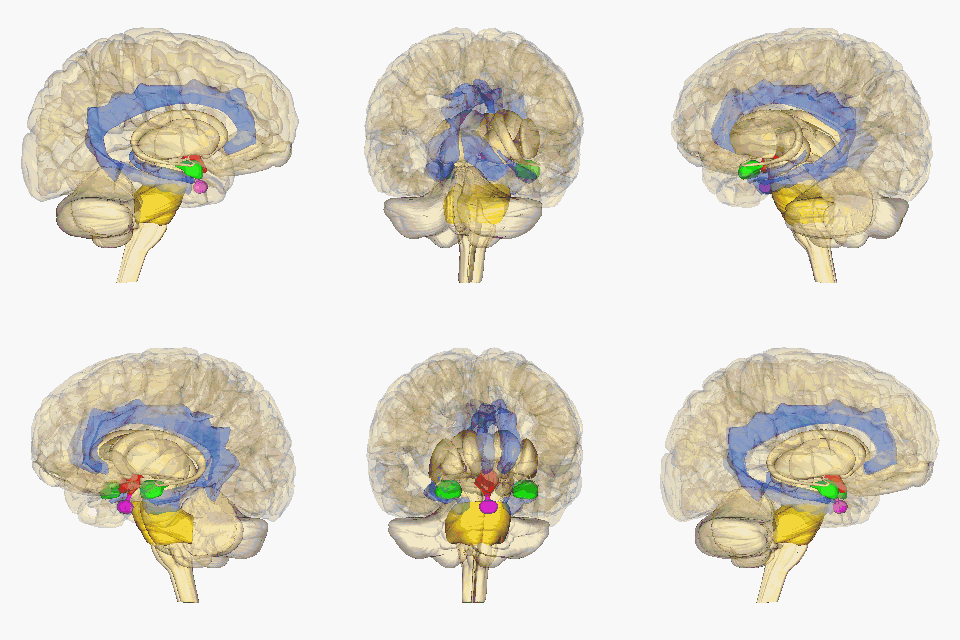
Human Brain by BrianMSweis
hypothalamus=red, amygdala=green,
hippocampus/fornix=blue,
pons=gold, pituitary gland=purple
CC image from Wikimedia Commons

Why do some stories 'work' really well? Why will some stories reduce an audience to tears, or silence, or a warm fuzzy glow?

I remember telling 'Oh Luck of the Ugly', a Sudanese folktale about an ugly girl and her struggle to find happiness, to some Year 12 girls in a Brisbane school. Many of them had tears in their eyes and were strongly moved by the story. We talked about it and then I asked them, "What do you think boys would do when they listen to this story?" They were collectively derisive. One said, "They would just laugh."

I said, "No. Year 12 boys listen carefully and, towards the end, go very quiet and thoughtful. This story effects them as well."

How does a 'good' story bring about this effect? Well, it seems that effective stories stimulate the brain to produce specific two brain chemicals - one, cortisol, encourages the story listener to 'concentrate' and the other, oxytocin, to 'empathise'.

As storytellers, we know that if we are going to tell a story it might as well be a good one. It needs to follow narrative structure and if you like the term, as script writers and movie directors do, the dramatic arc. It needs reachable characters, a setting we can imagine, a challenge or a problem to overcome and finally a clear resolution.

Now, if the character is similar to the audience and, if that problem is one that a particular audience has experience with or imagine they might and, if the resolution is one that has meaning in their lives then that story is going to move that audience. I bet those chemicals will start effecting the way your audience will 'be in the story space' and 'empathise' with the characters.

This video talk,  Empathy, Neurochemistry, and the Dramatic Arc: Paul Zak at the Future of StoryTelling 2012, is definitely worth watching. It will effect the way you think about stories.


Wednesday, January 30, 2013

What is the name of the tiger in The Life of Pi by Yann Martel?

We made it back to Brisbane in time for the floods this time.


Brisbane Flood Jan 2011
Great photo by Lil Foet, from Flickr, South Brisbane on the 6th January, 2013

Not that our house was flooded, it was long ago placed carefully on a hillside and I'm grateful.

We did lose power however. One of our neighbourhood trees in Dorchester Street stopped holding on for a second or two in the wild wind and that was all it took. The powerlines tried to catch it and, with some help from an optus cable and at least four poles, they did, but the power leaked everywhere until some kind person or machine turned off the switch and plunged us into darkness and refused us entry into the world of the Australian Open Singles final story.

Oh well, I had worked out who was going to triumph in that particular hero's journey when ex-cyclone Oswald took his revenge.

Perhaps more meaningfully, I did get to realize how dependent on electricity I have become - no power, no fridge, no computer and no TV and not much awareness of the trauma a whole lot of people went through with the 'cyclonic event'.

We did get to enjoy lots of candles and to realise how humid Brisbane can get even the wind is 'cyclonic'. The treat last night was getting out the little green ukulele after our dinner by candlelight and playing and singing songs to each other.

Earlier we had sought refuge in a nearby cinema, air conditioned of course, and were suitably entertained by 'The Life of Pi'. As Pi and the tiger were surviving great storms in the Pacific in a lifeboat, Oswald was wreaking havoc further south and, tragically, drowning two Asian backpacking farm labourers in the Lockyer Valley.

'Life of Pi' is a quite wonderful story, magically created on screen from Yann Martel's Booker winning book. I was also suitably entertained by the main point of the story, ie 'God is the more interesting story.'

After that fertile conditioning in the air conditioning, I was most certainly ripe for the subject line of an email/facebook/blog post I bumped up against this morning when we finally got power back - 'Tall Tales - the strength of storytelling'.

It wasn't bad and wasn't brilliant, well it lacked a bit after 'Life of Pi in 3D' and the wild Oswaldic winds. It was really an essay on why business people should tell stories. It has some nice points. One of the quotes from Alison Esse is, “Storytelling is the original and most powerful form of learning and sharing knowledge.”

That led me to thinking about

'When did storytelling evolve?' 'What came first, oral stories or visual stories?'

I looked online and, although it is a pretty murky area of research, it would seem that it was most likely to be oral storytelling. The first cave paintings were only 30,000 or 50,000 years ago and it seems likely that human speech has been around for a couple of hundred thousands of years.

So storytelling came first. Sorry writers and painters and sculptors and directors.

It also took me on a journey to another post on another electrically powered blog called - 'Your brain on narrative: evolution and the story rope' by Andrea Pitzer.


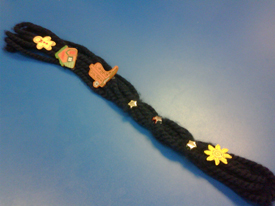
Which leads me to the story rope. I hadn't heard of them before but teachers probably have.  They're a bit like charm bracelets. Imagine a 'rope' of plaited wool and inserted into it in a line is approx 7 studs - one for a character, one for the setting, one for the problem, two or three for complications and a bright sunny one for the solution.

The one in Andrea Pitzer's article has a ginger bread man, a house, a cowboy boot, three small stars and a sun, respectively.


I wonder what symbols the storytelling rope for the 2013 floods would need? I think we could reuse the sun at least.

Oh the tiger was called Richard Parker. I probably should say tigers. Want more? Only go here if you don't care about tiger or tigers.

Sunday, October 14, 2012

Kuril, West End Crossing Boundaries and Ashgrove Young Explorers

Had a really enjoyable workshop at Ashgrove Library with the Young Explorers of Ashgrove History.

Uncle Nurdon Serico shared his knowledge of the local country and of the Turrbal people.

He reminded us of the Turrbal name for Ashgrove - Kallindarbin and of the fact that Waterworks Road was once an Aboriginal pathway leading to Mt Cootha and to the Bunya festival in the Bunya Mountains.

I remembered the Kuril Story that Vanessa Fisher told and painted for the Crossing  Boundaries project in 1997- 98. Here's the link. It's been archived on the Pandora site these days but it's still all there.

It was a great project. It would be good to do it again sometime, get some different stories and compare results.

Wednesday, October 10, 2012

Ashgrove local history stories and yarns

I had great pleasure telling my 'Clothes Props Man' story to children and adults at the Launch of the Creating Young Local Historians project at Ashgrove Library on Saturday.

Local History is all about stories really. Sure some people get bogged down in detail of dates, addresses and exactly what was said at times but really they are just getting bogged down in Narrative Structure or at least one part of it.

The other delightful story we had at the launch was the story of The Children's Coach. For some years around 1937 at St Finbarr's School in Ashgrove the kindergarten children were delivered by a horse and cart owned by the nuns.  Miss Pat Fahey was there at our launch to share the story about being one of the children photographed sitting in the buggy. She's the one sucking her thumb.

She reckons that it was probably because, although the horse plodded up the hill in Jubilee Tce where she was picked up, it used gallop along at a great rate along Waterworks Road and they all had to hang on.


If you would like to see what Pat looks like now have a look on our YEAH blog.

Really looking foward to our first children's workshop in the library on Saturday at the Ashgrove Library. Uncle Nurdon Serico is going to come along to tell us a story or two about Turrbal enjoyment of the area.

We'll have some games, technology, more stories and fun, so if you know of any children living in the greater Ashgrove area who would like something really different to do on Saturday here's the link to the information.

http://youngexplorersashgrovehistory.blogspot.com.au/2012/10/launch-of-creating-young-local.html

We'll be publishing stories, local history information, podcasts etc on the YEAH blog so you might like to follow our progress.

Daryll

Thursday, July 26, 2012

This Old Man He Told Stories

Wonderful day today of performing at kindergartens - Samford Community Kindergarten and Chapel Hill Community Kindergarten and running off a DVD of the ANTaR forum on 'Sovereignty in the 21st Century'.

I'm really enjoying adding more ukulele to my storytelling as well. Today we went for a choof down the track with 'Down By the Station, Early In the Morning' and that led into my 'Little Blue Train takes the children to the Zoo' story. Because the children at Samford have been exploring a space theme lately, I also improvised a story that started with 'This Old Man He Played One' song. When we got to 4, he played knick, knack on the door, the door creaked open and I asked the children 'who or what came out'. One girl said a ghost, so, of course, we all screamed and ran and ran and ran all the way to the space station and took off on the Lunar Explorer Mission as fast as we could.

You wouldn't guess who we ran into on the moon? Give up? It was that dreadful space pirate Captain Hook. He stole the treasure and blasted off to Mars. Did we get back? Of course we did. Came back to earth just in time to sing 'this old man he played five'. Good fun.

Chapel Hill's Kinders were dominated by boys and the energy was .... masculine, well 4 year old masculine. I did notice that the girls were having the most fun though. We finished with The Clever Turtle. At the end of the show, the children had a choice of strumming the uke while I did some chords or playing on the djembe. What value.

Stories are so much fun for all ages. It is important that we remember that as we embrace and work with the national curriculum.

Friday, July 13, 2012

Bringing stories alive and joyful Ted

Really enjoyed running a  bringing stories alive storytelling workshop for some very talented and dedicated kindergarten teachers today.

Wavell Heights Kindergarten is one of those very professional C&K kindergartens that add so much to our Qld society.

Enjoyed this Ted talk tonight.

Wednesday, July 11, 2012

Fair is Fair - World Folktales of Justice and Snow White

Have been reading some more of 'Fair is Fair - World Folktales of Justice' by Sharon Creeden. I bought this August House Publisher collection of folktales around the subject of justice at the NSW Storytelling Conference and have been dipping into it at regular intervals.

There's quite a range of stories both from different cultures and about different issues. One I enjoyed was 'The Two Otters and the Fox'. It's a short folktale from India and Indonesia about otters who are fighting over who should get the bigger share of the fish they've both caught. They ask the fox to solve the question for them and, of course, he makes off with the biggest share. The otters are left with an unexpected moral - fighting leads to losses.

This story can be used in so many ways, about bullying for example, but what came to my mind, I must admit, is the current fighting by the Australian political parties over refugees. We all lose by that fight, especially the refugees. More importantly though the political parties lose respect.

Another story in the book is 'Mr Fox'. I used to tell it a lot when I first started telling stories but I stopped. It is a pretty gruesome story. Sharon Creeden compares it to the serial killing of Ted Bundy. He was certainly gruesome. I still don't know if I want to tell it. It does have a brave hero, Lady Mary, and justice is done but it is capital punishment.

I find myself turning off TV a lot lately because of all of the murderous crime stories. Who needs them? I know I don't. What effect do they have on viewers? I don't know but I suspect that the balance is not positive. So should I tell Mr Fox or not? And in the words of a panto I saw as a child, 'That's the burning question. Let's have your suggestion.'

Who's seen 'Snow White and the Huntsman'?

I enjoyed it. Thought it was good storytelling in general. I liked the way they played with the Snow White story and brought in all sorts of other references from other folk tales, legends, movies, genres etc. - the three drops of blood on the snow, the rose, the witch and the ravens, the white hart and many more.

Snow White was quite Joan of Arc-ish riding into battle. If she was a contemporary country or nation which one would she be? What about the scarred women with the head scarves in the village by the lake? Iraq, Afghanistan, Vietnam?

The troll was cool but it was a bit of an anticlimax when he just slunk off. It demonstrated Snow Whites compassionate power but really they missed a good opportunity there. They went for  mono-cultural or mono-specific heroes. The closest thing to a non white human team members were the dwarfs and they were clearly white human, just a little quirky in a easily loveable way.

I thought it was interesting that, while there was lots of killing in the movie, most of the means of dying were not directly presented. I guess this was a way of making the killing more acceptable. It certainly worked.

Wednesday, June 20, 2012

Back in Bris, Little Tots and the Single Story

Back in Brisbane after corporate storytelling trip to Perth. It was a bit quick and I didn't manage to catch up with Perth storytellers. (Sorry about that WA storytellers.)

The session with Honda Australia salespeople and managers at the Burswood Entertainment Complex went well. It was good working with a local jazz band, John Bannister and The Charisma Brothers, as well. One thing I like about these corporate awards nights is the smiles on peoples faces as they are acknowledged for their hard work.

Really enjoyed our visit to the Art Gallery of WA. The Warholl to Picasso exhibition is definitely worth it and the general gallery collection is quite special. Good to see some old favourites again like Lin Onus's 'Maralinga'.

In my corporate storytelling presentation to Honda, I've been making the assertion that, 'If you want to oppress a culture one of the easiest ways to do it is to stop the people from telling their stories and especially stop them from telling their stories in their language.'

So today I was pleased to hear that idea expanded on in a Ted talk by ‪Chimamanda Adichie: 'The danger of a single story.'‬  She won me over very quickly with 'I'm a storyteller and I'd like to tell you a few personal stories about ...'  In her talk Chmamanda argues very eloquently about the effect of our tendency to simplify our perceptions of peoples and culture into - 'single stories'.

She says, among many other things, - 'Power is the ability not just to tell the story of another person but to make it the definitive story of that person.'


She finishes her talk with:

'When we reject the single story, when we realise that there is never a single story about any place, we regain a kind of paradise.'

I like that.

Told three different stories to some Little Tots children at Stretton today. So many different faces and cultures, all hungry for fun and stories. We had both but I do see that it is easy to slip into one type of story.


Thursday, June 07, 2012

Weaving corporates, festivals and dramatic boys.

Last weekend was great hobnobbing with storytellers from around Australia and overseas at the NSW storytelling guild's 'Weaving Stories Together' Conference in Sydney.


I can't decide if the highlight was listening to Dianne Ferlatte the keynote speaker and featured storyteller from the USA or the energy of the primary school boys who won the children's storytelling competition. Then again I did really enjoy the workshop by Graham Ross called 'Enriching the Perspective and Power of Historical Storytelling' and the 'Improvised Storytelling' workshop by Lillian Rodrigues Pang. Jenni Cargill Strong's workshop on bullying was really informative as well.

I've also been enjoying the corporate storytelling I've been doing with Honda Australia. An adult corporate audience is so different from a school or a community audience. There is so much content wrapped around the stories I've been presenting them. It is a buzz to do that walk on stage with the spotlight and the musicians providing backup. So if you walk into a Honda salesroom in the next 6 months and get told a story or two by the salesperson, you'll know why.

Kalinga Park playground, image with thanks by Graeme Lanham (Panoramio)


 A funny thing happened on Tuesday - World Environment Day. I was doing some performances for the Brisbane City Council Catchment Coordinators under a marquee beside Kedron Brook - lovely setting. My audiences were Catchment Kids - primary school children from different schools involved in the junior catchment protection programs. They were short shows, just 30 minutes which usually meant telling one story and improvising a second one with the audience about the catchment. At the end of the last show, I invited the audience to do a little drumming each on my African djembe.

I noticed one boy, probably in about Year 6 or so, stepping up quite excitedly. He was obviously planning how we would play the drum in a different way as I saw him clench his fists ready to punch it. I said, "No not with your fists please."

I saw him unclench is fists and I thought 'that's good,' but I wasn't ready for what he did next.

He head butted the drum, twice! and unfortunately split the skin, duh! Needless to say I wasn't very happy.

Still that drum and that goat skin has had a lot of use in the 10 years or so since I bought it. I dropped it in a Eumundi Drums yesterday for a new skin and for the time being I'm djembe-less. I'm experiencing some withdrawal symptoms, oh well.

Still being without the drum will spur me into experimenting with some new story support activities such as my green ukulele.

I've already improvised a new story that starts with the song 'This Old Man' it's pretty simple chords and lots of opportunities to branch out into different stories.

Today I was at Augusta State School out by Redbank Plains and had fun with the students there. I'll be back there tomorrow to do another three shows looking forward to telling and creating some more stories with them.


Daryll


Friday, March 30, 2012

Library Storytelling and Creative Advertising

Have just enjoyed two Brisbane City Council library performance gigs in the last two days:

- Wynnum Library storytime for the Wynnum up late program

- and the opening of the new Carindale Branch Library.

The Carindale Library children's area is really cute. Works pretty well for storytime as well.

While I was at Wynnum I was making up a song:

'Pelicans and Seagulls, Pelicans and Seagulls are flying overhead, are flying overhead,
Pelicans and Seagulls like eating fish and chips.'

I like Pelicans but sometimes those Seagulls get just a bit pesky.

Someone sent me an email with a great advert on YouTube where a seagull gets his just deserts from some well organised crabs. Here's the link. (It's fine for children so long as you take some parental care around some of the other YouTube content that might pop up around it.)

I can see a story coming on with crabs in it for sure.


Regards

Daryll

Sunday, February 05, 2012

Riverview Stories and the Aboriginal Frog

Enjoying my participation in the Riverview School Artist in Residence project. I'm helping students enjoy the experience of telling stories and creating them.

There's a great photo and article about the project  on the Queensland Times newspaper website.


It was great to have Aunty Ruth Moffat drop in to listen to some of her grandchildren taking part. She told us some of her stories of working as a Teacher's Aid at Riverview (among other places). One of the little anecdotes she shared was of a young girl telling her that she had 'seen an Aboriginal frog' at her place. When Aunty Ruth asked her why it was an Aboriginal frog, the girl said, "That's because it's covered in dots."

The students loved the story of course so we added it to the story we created about a visit by the Riverview School Christmas Choir visit to Riverview Gardens Retirement Village.

I love this sort of working, being able to share stories and retell them in completely different  settings.

Mind you, you have to be quite flexible working in a school. We were recording our story as we created it and I had 4 students singing Rudolf the Red Nose Reindeer as if they were performing at the retirement village. It sounded great. We advanced the story and got in the frog and I turned to our 'choir' to record them singing again but I had found that 3 of the 4 had left to catch buses. Our remaining choir member rose to the occasion however and sang our improvised song quite brilliantly.

Another quite wonderful adaption was finding out that one of the original choir members 'wasn't really in the choir' and that, despite a disability, had won the school comedy competition last year. I asked her if we could record her pretending to tell a joke at Riverview Gardens. She did so swimmingly:

'Why did the fish cross the sea?"

"Why?"

"To get to the other tide."

I'm hoping Aunty Ruth will come back and tell us some of her stolen generation story. The multipurpose hall at Riverview is named after her husband Uncle Jack who sadly passed away in 2008.

You can read some of her story on the Goodna State School website at:

http://www.goodnaschool.net/indig_perspective/ruth_moffatt.html