Wednesday, May 29, 2013

Readers Cup, Owls and Enchantment of Stories

I'm feeling really good about being a storyteller this afternoon. I'm just back from a couple of shows at Redlands College Library for the local annual Readers Cup event. Had fun telling 'Clever Turtle' to the Year 4's in a way that demonstrated telling to Year 1's and 'Thomas Rhuag the Seal Catcher' to the Year 8 and 9's.

They're both well worn old favourites of mine and were well received. One of the Year 9's volunteered a thank you after  the Librarian had already done so and then came over later to add her own personal thanks. Stories really do impress and involve and engage.

One of the teachers remembered me from the gig I used to do at Cleveland and Capalaba Libraries some years back. She said her then preschooler, now 20 year old son, was normally hyperactive but would sit and listen and join in so well. They were great sessions those. We were able to put so many things together well for our young audiences.

As part of my presentation I was talking about using props and keeping them simple. I demonstrated a wooden owl shaped whistle and mentioned the stories created for the Enchanted Forest Park at Ashgrove. I was pleased to be told by one of the Yr 9's that she really enjoyed the park.

Coming home I found an email from Cindy Anderson saying:

'My 4 year old son has recently rediscovered the Enchanted Forest at Ashgrove. Although we have been to the park many times over the years, he has only just realised that the mushroom tells stories and is completely enthralled by them. We are now going a couple of times a week so he can sit and listen to them! It's such a great place and experience and I am truly grateful to you for your role in creating it. It's so wonderful that kids can still experience such a joy in something so age old and lovely.'

Isn't that wonderful!

Section of the Enchanted Forest Playground in Dorrington Park, Ashgrove, Brisbane


View Enchanted Forest Playground in a larger map


Wednesday, May 22, 2013

Splashing Around the Catchment Recovery Project


Loved this 2012 project. It really showed the value of creating and telling stories as part of recovery from disasters. Good thinks happen in the Lockyer Catchment.

Friday, March 01, 2013

Revolutionary Optimists

Video, social networking and digital storytelling can support social action.

Here's a wonderful little story that send shivers up my spine and makes me teary.


Revolutionary Optimists TEDxChange 2012 from Grainger-Monsen Newnham on Vimeo.
So many narrative elements and good storytelling here. It gives me heart for the future of storytelling in the digital social networking age.


 Certainly a bit more effective than this effort by one of the worlds multinationals.


Still for an advert that's not too bad. He is telling a story in his own voice, nice settings, bit of an issue. Doesn't send shivers up my spine though.


Here's another advert with lots of little stories.


They are sort of inspiring but could be a lot more so.

The people are all alive. That's probably the best thing about them.

The settings are very general 'urban'. There's a limit to how much the listener/viewer can go on a journey to them.

Narrative problems? Naa. This multinational doesn't want to associated with problems.

This means the resolutions, although sweet and life affirming, are not very effective story wise.

Monday, February 04, 2013

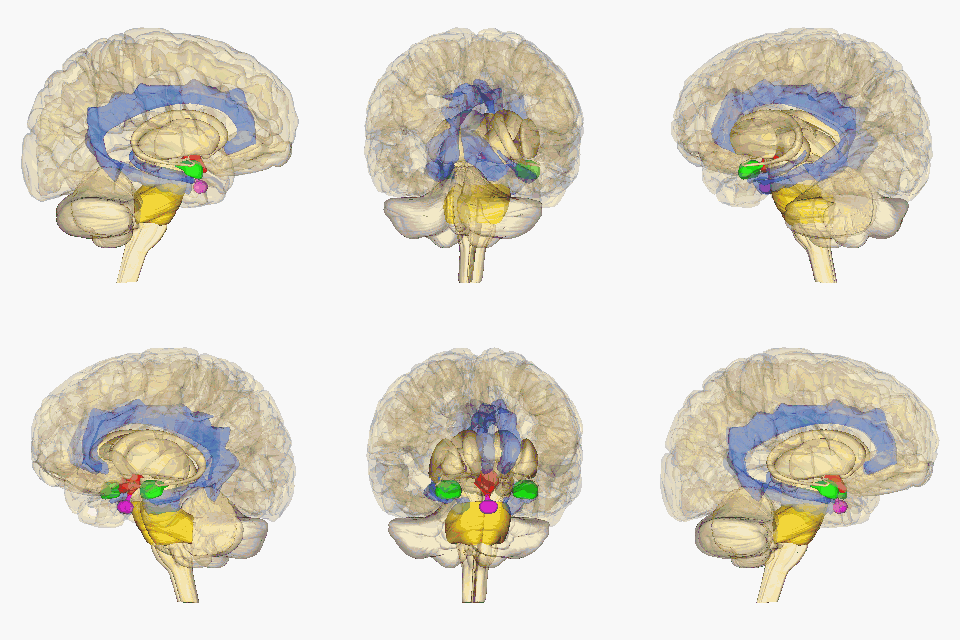
Effective stories produce brain chemicals

Human Brain by BrianMSweis
hypothalamus=red, amygdala=green,
hippocampus/fornix=blue,
pons=gold, pituitary gland=purple
CC image from Wikimedia Commons

Why do some stories 'work' really well? Why will some stories reduce an audience to tears, or silence, or a warm fuzzy glow?

I remember telling 'Oh Luck of the Ugly', a Sudanese folktale about an ugly girl and her struggle to find happiness, to some Year 12 girls in a Brisbane school. Many of them had tears in their eyes and were strongly moved by the story. We talked about it and then I asked them, "What do you think boys would do when they listen to this story?" They were collectively derisive. One said, "They would just laugh."

I said, "No. Year 12 boys listen carefully and, towards the end, go very quiet and thoughtful. This story effects them as well."

How does a 'good' story bring about this effect? Well, it seems that effective stories stimulate the brain to produce specific two brain chemicals - one, cortisol, encourages the story listener to 'concentrate' and the other, oxytocin, to 'empathise'.

As storytellers, we know that if we are going to tell a story it might as well be a good one. It needs to follow narrative structure and if you like the term, as script writers and movie directors do, the dramatic arc. It needs reachable characters, a setting we can imagine, a challenge or a problem to overcome and finally a clear resolution.

Now, if the character is similar to the audience and, if that problem is one that a particular audience has experience with or imagine they might and, if the resolution is one that has meaning in their lives then that story is going to move that audience. I bet those chemicals will start effecting the way your audience will 'be in the story space' and 'empathise' with the characters.

This video talk,  Empathy, Neurochemistry, and the Dramatic Arc: Paul Zak at the Future of StoryTelling 2012, is definitely worth watching. It will effect the way you think about stories.


Wednesday, January 30, 2013

What is the name of the tiger in The Life of Pi by Yann Martel?

We made it back to Brisbane in time for the floods this time.


Brisbane Flood Jan 2011
Great photo by Lil Foet, from Flickr, South Brisbane on the 6th January, 2013

Not that our house was flooded, it was long ago placed carefully on a hillside and I'm grateful.

We did lose power however. One of our neighbourhood trees in Dorchester Street stopped holding on for a second or two in the wild wind and that was all it took. The powerlines tried to catch it and, with some help from an optus cable and at least four poles, they did, but the power leaked everywhere until some kind person or machine turned off the switch and plunged us into darkness and refused us entry into the world of the Australian Open Singles final story.

Oh well, I had worked out who was going to triumph in that particular hero's journey when ex-cyclone Oswald took his revenge.

Perhaps more meaningfully, I did get to realize how dependent on electricity I have become - no power, no fridge, no computer and no TV and not much awareness of the trauma a whole lot of people went through with the 'cyclonic event'.

We did get to enjoy lots of candles and to realise how humid Brisbane can get even the wind is 'cyclonic'. The treat last night was getting out the little green ukulele after our dinner by candlelight and playing and singing songs to each other.

Earlier we had sought refuge in a nearby cinema, air conditioned of course, and were suitably entertained by 'The Life of Pi'. As Pi and the tiger were surviving great storms in the Pacific in a lifeboat, Oswald was wreaking havoc further south and, tragically, drowning two Asian backpacking farm labourers in the Lockyer Valley.

'Life of Pi' is a quite wonderful story, magically created on screen from Yann Martel's Booker winning book. I was also suitably entertained by the main point of the story, ie 'God is the more interesting story.'

After that fertile conditioning in the air conditioning, I was most certainly ripe for the subject line of an email/facebook/blog post I bumped up against this morning when we finally got power back - 'Tall Tales - the strength of storytelling'.

It wasn't bad and wasn't brilliant, well it lacked a bit after 'Life of Pi in 3D' and the wild Oswaldic winds. It was really an essay on why business people should tell stories. It has some nice points. One of the quotes from Alison Esse is, “Storytelling is the original and most powerful form of learning and sharing knowledge.”

That led me to thinking about

'When did storytelling evolve?' 'What came first, oral stories or visual stories?'

I looked online and, although it is a pretty murky area of research, it would seem that it was most likely to be oral storytelling. The first cave paintings were only 30,000 or 50,000 years ago and it seems likely that human speech has been around for a couple of hundred thousands of years.

So storytelling came first. Sorry writers and painters and sculptors and directors.

It also took me on a journey to another post on another electrically powered blog called - 'Your brain on narrative: evolution and the story rope' by Andrea Pitzer.


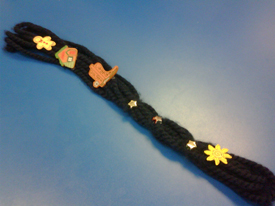
Which leads me to the story rope. I hadn't heard of them before but teachers probably have.  They're a bit like charm bracelets. Imagine a 'rope' of plaited wool and inserted into it in a line is approx 7 studs - one for a character, one for the setting, one for the problem, two or three for complications and a bright sunny one for the solution.

The one in Andrea Pitzer's article has a ginger bread man, a house, a cowboy boot, three small stars and a sun, respectively.


I wonder what symbols the storytelling rope for the 2013 floods would need? I think we could reuse the sun at least.

Oh the tiger was called Richard Parker. I probably should say tigers. Want more? Only go here if you don't care about tiger or tigers.

Sunday, October 14, 2012

Kuril, West End Crossing Boundaries and Ashgrove Young Explorers

Had a really enjoyable workshop at Ashgrove Library with the Young Explorers of Ashgrove History.

Uncle Nurdon Serico shared his knowledge of the local country and of the Turrbal people.

He reminded us of the Turrbal name for Ashgrove - Kallindarbin and of the fact that Waterworks Road was once an Aboriginal pathway leading to Mt Cootha and to the Bunya festival in the Bunya Mountains.

I remembered the Kuril Story that Vanessa Fisher told and painted for the Crossing  Boundaries project in 1997- 98. Here's the link. It's been archived on the Pandora site these days but it's still all there.

It was a great project. It would be good to do it again sometime, get some different stories and compare results.

Wednesday, October 10, 2012

Ashgrove local history stories and yarns

I had great pleasure telling my 'Clothes Props Man' story to children and adults at the Launch of the Creating Young Local Historians project at Ashgrove Library on Saturday.

Local History is all about stories really. Sure some people get bogged down in detail of dates, addresses and exactly what was said at times but really they are just getting bogged down in Narrative Structure or at least one part of it.

The other delightful story we had at the launch was the story of The Children's Coach. For some years around 1937 at St Finbarr's School in Ashgrove the kindergarten children were delivered by a horse and cart owned by the nuns.  Miss Pat Fahey was there at our launch to share the story about being one of the children photographed sitting in the buggy. She's the one sucking her thumb.

She reckons that it was probably because, although the horse plodded up the hill in Jubilee Tce where she was picked up, it used gallop along at a great rate along Waterworks Road and they all had to hang on.


If you would like to see what Pat looks like now have a look on our YEAH blog.

Really looking foward to our first children's workshop in the library on Saturday at the Ashgrove Library. Uncle Nurdon Serico is going to come along to tell us a story or two about Turrbal enjoyment of the area.

We'll have some games, technology, more stories and fun, so if you know of any children living in the greater Ashgrove area who would like something really different to do on Saturday here's the link to the information.

http://youngexplorersashgrovehistory.blogspot.com.au/2012/10/launch-of-creating-young-local.html

We'll be publishing stories, local history information, podcasts etc on the YEAH blog so you might like to follow our progress.

Daryll